Patent Applications Cannot Be Rejected Merely Due to an Unnotarised or Unregistered Power of Attorney: Madras High Court
News Brief & Key Summary
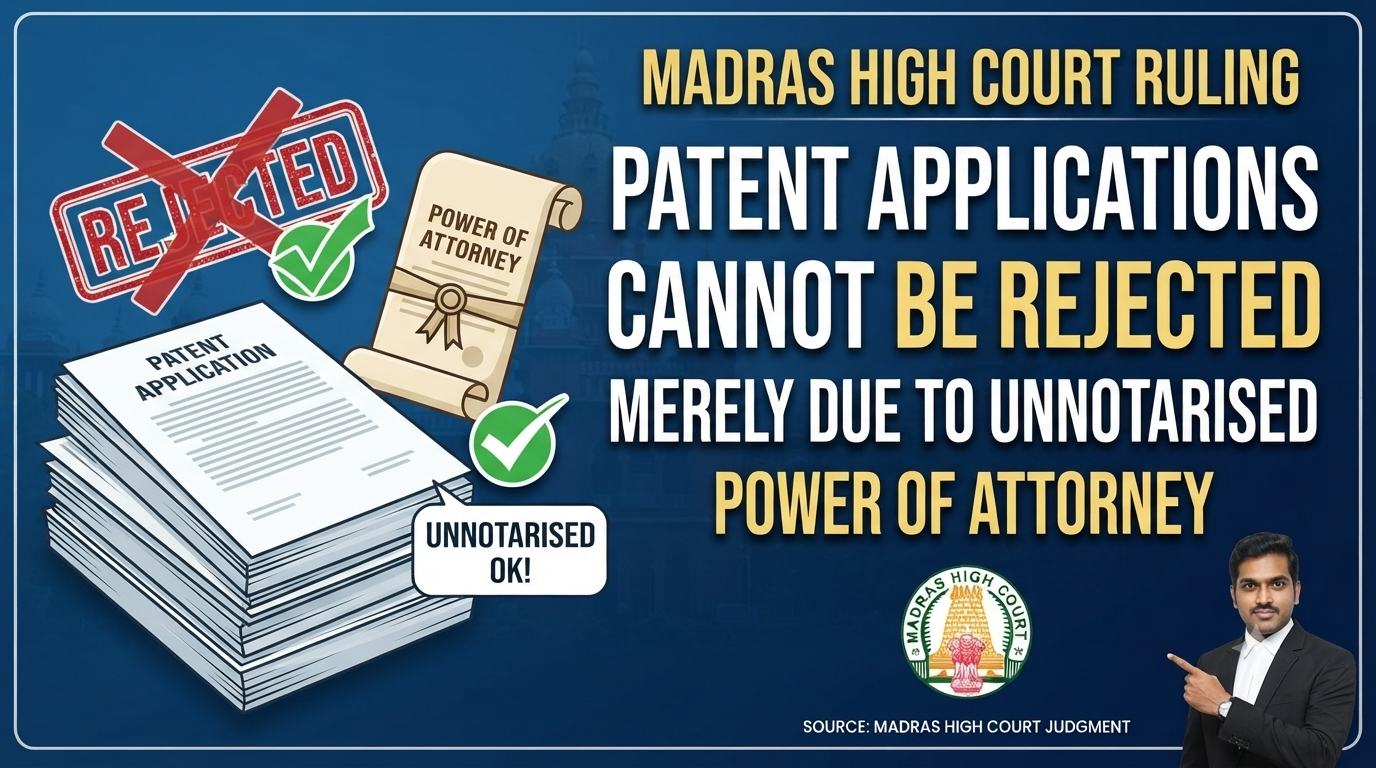
The Madras High Court has clarified that a patent application cannot be rejected merely because the Power of Attorney authorising a patent agent is unnotarised or unregistered. In Qualcomm Incorporated v. Assistant Controller of Patents and Designs, the Court held that the Patents Act, 1970 and Patent Rules, 2003 do not prescribe such mandatory requirements. The rejection order was set aside, with directions for fresh consideration after an opportunity of hearing.
Key Highlights & Legal Provisions
- 📜The Madras High Court ruled that patent applications cannot be rejected merely because the Power of Attorney (PoA) is unnotarised or unregistered.
- 📜The Patents Act, 1970 and Patent Rules, 2003 do not prescribe mandatory notarisation or registration of such PoAs.
- 📜Insisting on Form 26 or additional authentication requirements without statutory authority amounts to a hyper-technical approach.
- 📜The Court set aside the rejection order and directed fresh consideration after granting an opportunity of hearing.
Important Documents / Judgment Points
Case Name: Qualcomm Incorporated v. Assistant Controller of Patents and Designs
Court: Madras High Court
**Legislation Involved:
- 1.Patents Act, 1970
- 2.Patents Rules, 2003
**Key Legal Principle: **Procedural requirements in patent prosecution must have statutory backing. Authorities cannot impose additional conditions that are not prescribed under the applicable law.
Full Update / Official Details
The Madras High Court, in Qualcomm Incorporated v. Assistant Controller of Patents and Designs, has clarified that a patent application cannot be rejected merely on the ground that the Power of Attorney (PoA) authorising a patent agent is neither notarised nor registered.
The Court observed that neither the Patents Act, 1970, nor the Patent Rules, 2003 prescribe any mandatory requirement for notarisation or registration of a Power of Attorney authorising a patent agent to represent an applicant.
The Court further clarified that insisting upon Form 26, extending affidavit authentication requirements to a Power of Attorney, or questioning the authority of a patent agent in the absence of any dispute raised by the applicant would constitute an overly technical approach.
Emphasising the importance of following statutory provisions, the Court held that procedural requirements cannot be expanded by imposing additional conditions that have no legal basis under the applicable patent framework.
Accordingly, the Madras High Court set aside the rejection order and directed the concerned authority to reconsider the matter after providing the applicant with an opportunity of hearing.

Written and verified by our senior educational counselor and legal career analyst. Our editorial team rigorously tracks authentic government portals, official gazettes, and university boards to deliver verified vacancies, syllabus details, and application deadlines on time.